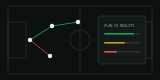
Every coach knows the feeling: the team talk was clear, everyone nodded, and on the pitch something else happened. Was it the plan that was wrong, or the way it was applied? Without a way to check, the debrief turns into a debate.
The answer starts before the match, with how you write your instructions.
Vague instructions can't be evaluated
"Be more aggressive", "stay compact", "play forward": everyone understands them, but nobody can say afterwards whether they were followed. Compare them with:
| Vague | Measurable |
|---|---|
| Be aggressive without the ball | Press the ball carrier within 5 seconds after losing possession |
| Stay compact | Keep less than 30 m between the defensive and midfield lines |
| Use the width | Switch play to the weak side when the strong side is closed |
| Be dangerous on the left | Left back overlaps on every set attack down the left |
A measurable instruction has three parts: a situation (after a turnover), an expected action (press the ball carrier) and a threshold (within 5 seconds).
Separate team and individual instructions
Some instructions apply to the whole team, like the defensive block or the pressing trigger. Others are aimed at one player: the striker who must press the centre-back, the full-back who must overlap. Keep two lists. After the match, they answer two different questions: did the team apply the plan? and did each player do his job?
After the match: three possible outcomes
For each instruction, count the situations where it applied and the times it was followed. You will usually land in one of three cases:
- Followed (roughly three times out of four or more). The instruction is understood. If the result was still poor, question the plan itself.
- Partial (around half the time). Look at when it stopped: fatigue, score, substitutions. This is often a fitness or concentration issue.
- Not followed. Either the instruction wasn't understood, or players didn't believe in it, or the opponent made it impossible. Ask your players before deciding.
The exact thresholds are yours to set. What matters is that you use the same ones every week, so you can compare matches.
Don't forget what worked
A debrief that only lists failures is hard to hear. Start with the instructions that were followed and show the clips. It confirms that the work done in training pays off, and makes the rest of the conversation easier.
Track it over the season
One match is a snapshot. Ten matches show a trend: an instruction that is never followed may need to be coached differently, or dropped. An instruction that improves week after week shows your sessions are working.
Where Ciprio fits in
This is exactly the comparison Ciprio is designed to automate: your game plan on one side, the full match video on the other, and for every instruction, a status, a ratio and the clips to back it up, for the team and for each player.
Ciprio is in development. Join the waitlist to be told when early access opens.