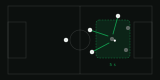
What counter-pressing means
Counter-pressing (or gegenpressing) is the reaction of a team in the seconds after it loses the ball. Instead of dropping back into position, the nearest players immediately press the new ball carrier and close the passing lanes around him.
The idea is simple: at the moment of a turnover, the opponent is not yet organised to attack. Their players are still positioned to defend. If you win the ball back quickly, you often find space close to their goal.
Why five seconds?
The "five-second rule" was popularised by Pep Guardiola's Barcelona: after losing the ball, the team had a few seconds to win it back before switching to a more organised defensive shape. The exact number matters less than the principle: a short, intense window, after which pressing becomes risky and tiring.
For amateur teams, the window is a useful coaching tool because it is easy to explain and easy to check.
How to measure it from your footage
You only need to look at turnovers. For each time your team loses the ball, note three things:
- Reaction: did at least one player press the ball carrier within five seconds?
- Numbers: how many players joined the press? One player alone is easily bypassed; two or three close the options.
- Outcome: was the ball won back, did the opponent play a long ball, or did they escape the press?
At the end of the match, you get a simple ratio: turnovers pressed within five seconds / total turnovers. Split it into 15-minute periods and the story usually becomes obvious.
What the numbers usually show
- A drop after the hour mark. Counter-pressing is physically demanding. If the ratio collapses after 60 or 65 minutes, it is a conditioning or substitution question, not a tactical one.
- One player who never reacts. Often a winger or a striker. Individual feedback, with two or three clips, usually fixes it faster than a team talk.
- Pressing alone. A high reaction rate but few balls won often means players press one by one. Work on the second and third player arriving together.
Coaching it during the week
Small-sided games with a rule are the most direct way to train it: in a possession game, a team that loses the ball scores a point if it wins it back within five seconds. Players learn the reflex without a long explanation, and the ratio in your next match will tell you if it worked.
Where Ciprio fits in
Counting every turnover by hand is long. Ciprio is being built to detect turnovers, measure the time until the first pressure, and show you the ratio for the team and for each player, period by period, with the clips attached.
Ciprio is in development. Join the waitlist to be told when early access opens.